Can You Go Cliff Jumping In El Yunque?
Cliff jumping in El Yunque: where jumps actually happen, what the Forest Service allows, the flash-flood risk, and how to pick a tour that gets you to the water safely.
Can You Go Cliff Jumping In El Yunque?
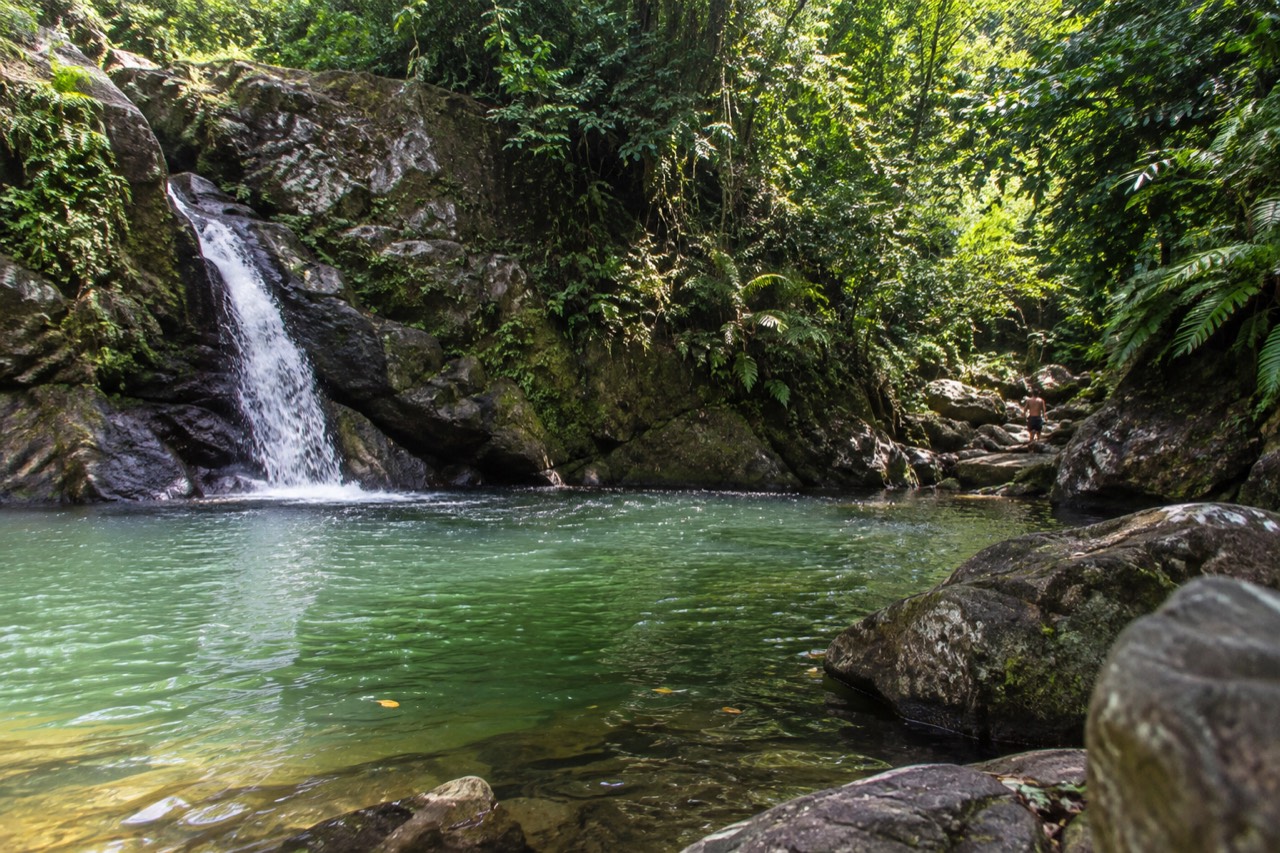
Not as a general permission, no. The Forest Service does not list cliff jumping among El Yunque's recreation opportunities, and several famous jump spots around Luquillo sit on private land outside the forest boundary. Cliff jumps do happen on guided tours, at specific operator-run spots, with a guide reading the water. That is the honest version, and the rest of this page unpacks it.
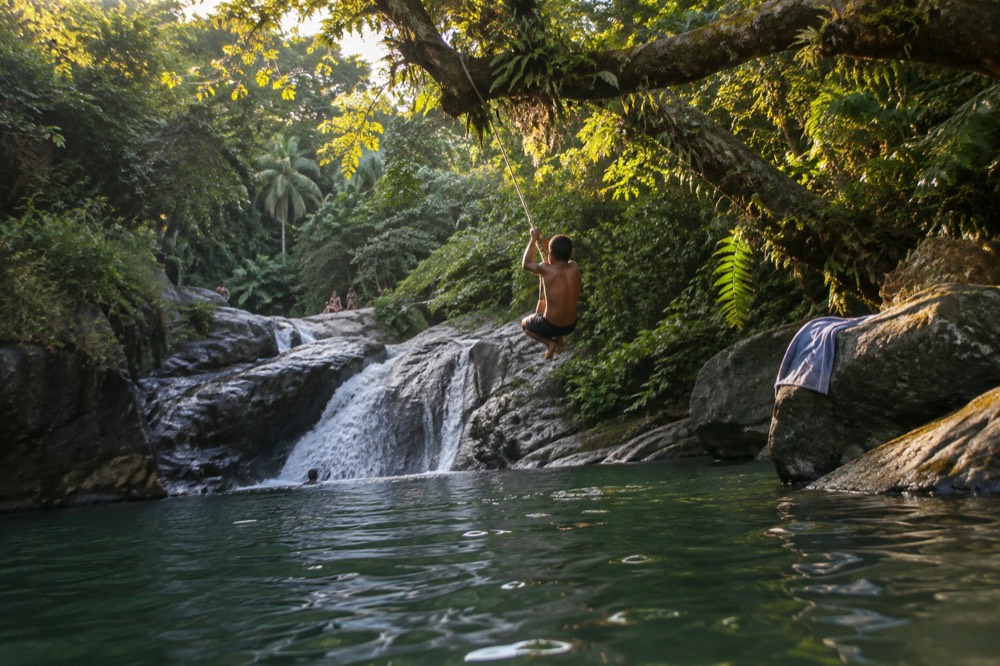
The short answer surprises people who have watched the videos. Search for El Yunque cliff jumping and you will find travellers leaping from rocks into green pools, swinging on ropes and sliding down chutes worn into stone. All of that is real. What is not real is the caption that usually accompanies it, the one that puts all of it inside the national forest under Forest Service rules.
The USDA Forest Service manages El Yunque, the only tropical rainforest within the national forest system, and its recreation pages list what visitors may actually do at each site: hiking, scenic viewing, interpretive exhibits, and swimming at a defined set of river spots. Cliff jumping appears on none of them. The jumps you see in those videos happen either on private land around Luquillo, most famously the natural waterslides at Las Paylas, or at specific swimming holes where a tour operator runs the activity and manages the risk on the day.
That distinction matters more here than at most destinations, and it is worth understanding before you book anything. A tour that sells cliff jumping is not selling you a Forest Service attraction. It is selling you a guided experience at a water feature, sometimes inside the forest, often outside it, with someone who knows the spot, knows the water level that day, and knows which ledge is safe after rain. Whether that is worth paying for is a separate question, and this page gets to it.
If your heart is set on the water rather than the trail, these are the trips that consistently deliver it:
Where The Cliff Jumps Actually Happen
Most jumps happen on the Luquillo side of the mountains, on private land outside the national forest, at spots like the Las Paylas waterslides and the river pools above them. Inside the forest itself, jumps occur only at guided swim stops on listed rivers, never as a free-for-all. The location determines the rules, the oversight and the risk.
Start with geography, because it decides everything else. The famous natural waterslides above Luquillo, the ones that dominate El Yunque tour marketing, sit on private land. Point-testing the coordinates against the Forest Service's own boundary and ownership data layers returns zero features: no national forest, no Forest Service ownership. The agency publishes 37 recreation sites and trails for El Yunque, and Las Paylas is not one of them. Access is arranged with the landowners on the spot, and the Forest Service provides no staffing, patrols or safety oversight there.
This is not a technicality. A tour that visits the waterslides is taking you outside the national forest, which changes what you are buying. You are not entering a Forest Service recreation site with agency-maintained infrastructure. You are visiting private property with an owner's arrangement, in the company of an operator who runs that route regularly. That can be a perfectly good day out, but you should know it before you pay, and you can read more in our guide to Luquillo waterslides tours.
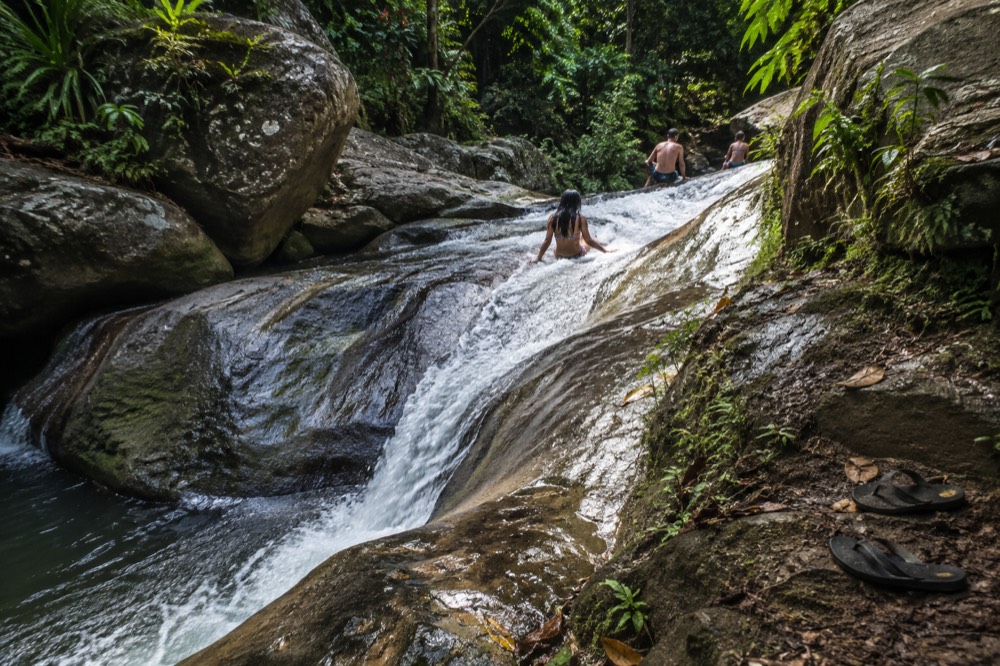
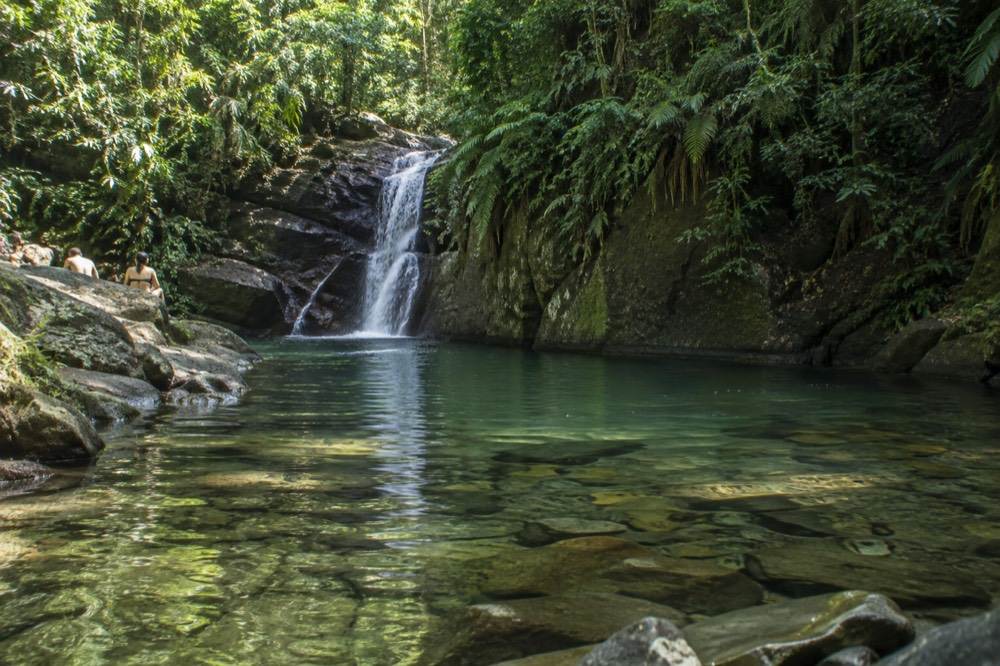
Inside the forest boundary, the water story is different. The Forest Service lists swimming as an opportunity at specific sites: the Juan Diego Falls pool, the Angelito Trail's Las Damas Pool on the Río Mameyes, Puente Roto, Quebrada Grande, Quebrada Sonadora, the Río Espíritu Santo Observation Point and the Río Sabana Recreation Area. These are rivers and pools, not jump parks. Tour groups swim at some of them, and where a guide is present, jumps and rope swings happen under the operator's eye. The Forest Service itself does not advertise jumping at any of them.
The two headline waterfalls complicate the picture further. La Coca Falls is a roadside viewing stop: the drop is 85 feet onto rocks, and swimming is not a listed opportunity. La Mina Falls, historically the forest's most famous swimming hole, has both of its access trails, La Mina and Big Tree, closed for construction and storm recovery, and the Forest Service's FAQ says plainly that the trail and falls remain closed. Any listing that promises swimming at La Mina today is selling something the forest does not currently offer; treat that as the listing's claim, not a fact, and check the official alerts page before your visit.
So the honest map of cliff jumping around El Yunque has three zones: private land outside the forest where slides and jumps are the main business, listed river spots inside the forest where guided groups swim, and closed or view-only waterfalls where nobody should be jumping at all. A good tour puts you in the first two zones with someone who knows the difference.
Is Cliff Jumping Legal Inside The Forest?
No Forest Service page permits it, and none bans it by name. The agency lists the activities allowed at each recreation site, and cliff jumping is not among them. Jumping at a listed swim spot is tolerated when a permitted operator runs it, but it is not a right, and jumping at closed or view-only sites is simply not something any honest guide will arrange.
The regulatory structure here is quiet but firm. El Yunque's recreation sites each carry a list of opportunities: viewing scenery, hiking, interpretive exhibits, and at the water sites, swimming. There is no cliff-jumping designation anywhere in the forest. What exists instead is a directory of authorized and permitted tour operators, published by the Forest Service, and a strong official preference that visitors use authorized transportation and authorized providers.
That preference has teeth in unexpected places. The Forest Service warns that the recreational corridor and the El Portal visitor center are not authorized pick-up or drop-off points for rideshare apps, and that not every taxi driver holds a permit to operate in the forest. A visitor who drives in, jumps in a river and then tries to call a ride out can find themselves walking a long way to a legal pick-up point. This is one of the quiet, practical reasons guided water tours around El Yunque sell as well as they do: the vehicle is permitted, the drop-off is legal, and the exit is solved.
If you are weighing a guided day on the water, the Water Slide & Rope Swing tour with Pickup is built exactly around this problem. It runs about 5 hours with hotel pickup, is rated 4.8 across 64 reviews on the live listing, and starts from $70 per person with free cancellation, which matters when rain reshuffles your week.
The permission question also runs the other way, toward what travellers report. Reviews on the live listings for these tours describe cliff jumps, rope swings and natural waterslides in detail, and those descriptions are genuine accounts of real days. But a traveller's description of their own jump is not a permission slip for yours. The jumps happen at specific operator-run spots, several outside the federal forest boundary, and generalizing them into "you can cliff jump in El Yunque" is exactly the kind of claim this site exists to correct. For the fuller picture on what the Forest Service actually allows in the water, see our piece on whether you can swim at El Yunque.
The Forest Service's Listed Swimming Spots
Seven sites inside the forest carry swimming as a listed opportunity: Juan Diego Falls pool, Angelito Trail and Las Damas Pool on the Río Mameyes, Puente Roto, Quebrada Grande, Quebrada Sonadora, the Río Espíritu Santo Observation Point and the Río Sabana Recreation Area. Each pairs with the same flash-flood warning. These are the honest swim stops; jumps happen at some of them under a guide's judgment.
Here is what the official record actually says, site by site, so you can see the shape of the permitted water:
| Site | What the Forest Service lists | Notes for a visitor |
|---|---|---|
| Juan Diego Falls (PR-191, km 9.6) | Short path to a natural pool you can wade into; swimming listed | 30-minute maximum parking due to limited capacity |
| Angelito Trail / Las Damas Pool (Road 988, Luquillo) | Easy 0.4 km trail down to the Río Mameyes; swimming listed | Family-friendly; carries the flash-flood warning |
| Puente Roto (Road 988) | Swimming listed | Road under construction, drive carefully |
| Quebrada Grande (Río Grande) | Swimming listed | Poor road conditions, drive carefully |
| Quebrada Sonadora | Swimming listed | Standard flash-flood warning applies |
| Río Espíritu Santo Observation Point | Swimming listed | On the Road 186 scenic byway side |
| Río Sabana Recreation Area (Naguabo) | Swimming listed | On the south side of the forest |
Notice what is absent from that table. La Coca Falls: viewing only, 85 feet of water onto rock, no swimming listed. Baño Grande: a beautiful 1930s stone pool that has been closed to swimmers since 1968 and is posted "No swimming permitted." Baño de Oro: a former swimming hole, now a photo spot on the National Register. La Mina Falls: both access trails closed. None of these is a jump site, and a great deal of third-party copy gets at least one of them wrong. Other pages covering the same trip are gathered on El Yunque National Forest Tours.
The two Luquillo-side road-access sites deserve a special note because they are where tour groups actually gather. Puente Roto and Quebrada Grande both carry current road-condition warnings from the Forest Service, which is a reminder that the practical side of a forest water day is logistics, not just permits. A permitted tour vehicle solves the road, the parking and the pick-up in one move.
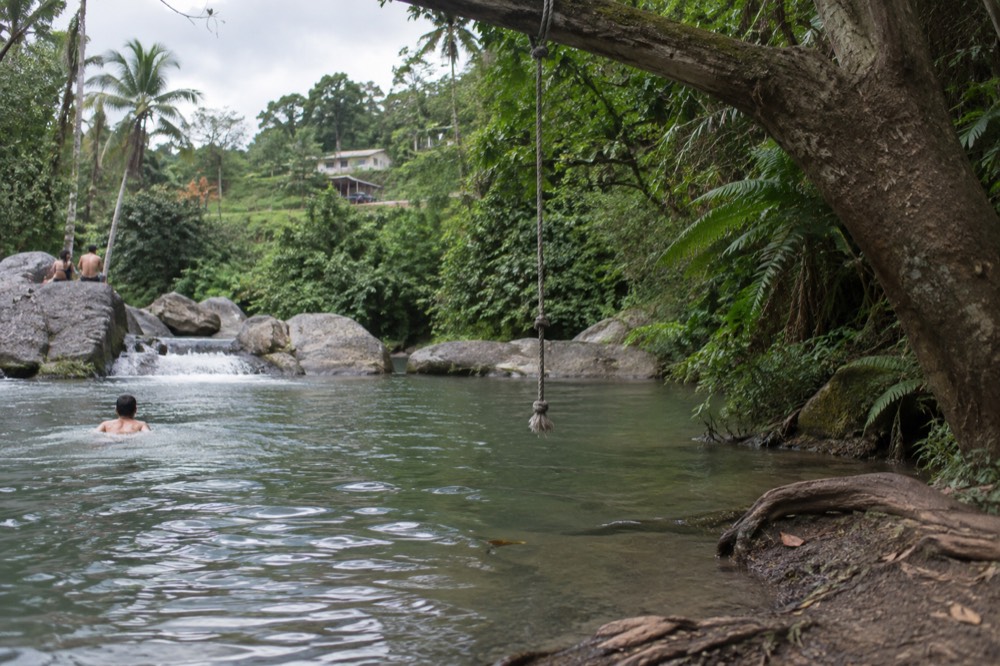
One more detail that most first-page results miss: the Río Mameyes has a live USGS stream gauge, site 50065500 near Sabana, publishing real-time discharge and gage height. You can literally check the river before you get in it. A guide does this for you; a self-driver with a phone can do it too. Either way, the data exists, and the live gauge page is worth a look the morning of any swim day.
Flash Floods: The Risk That Actually Matters
The Forest Service warns that flash floods can occur year-round, are more frequent in April and May, and that a sudden surge can claim victims in less than one minute, with flood water reaching 30 feet or more. Every listed swim spot carries this warning. It is the single most important safety fact on this page, and it is why a guide who reads the water is worth having.
The agency's own flooding page does not soften any of this. Rapidly rising water during a flash flood can roll boulders and vehicles, tear out trees, destroy bridges and undermine roads. The safety checklist is blunt: monitor NOAA weather radio, stay alert for heavy rain not just where you are but upstream, watch for rising water, get to higher ground, and do not cross flowing streams. A flash flood watch means threatening weather is possible; a warning means you may have only seconds.
This is the context in which cliff jumping around El Yunque has to be judged. A jump itself is a moment of personal risk, the kind you can see and choose. A flash flood is a systemic risk, the kind that arrives from a rainstorm you cannot see, several kilometers upstream, in a forest where annual rainfall ranges from roughly 96 inches at lower elevations to over 157 inches at the higher stations. The water you jumped into an hour ago is not the water that will be there when a surge comes through.
The rainfall numbers deserve a beat of respect. Research from the Forest Service's International Institute of Tropical Forestry records the highest annual rainfall, 4,300 millimeters, at El Yunque Peak itself, and one station, La Mina, recorded annual totals varying between 3,730 and 6,450 millimeters across eight years. This is a genuinely wet place. Rain on your itinerary is normal and should not ruin a trip, but rain upstream of your swimming hole is the thing that closes rivers.
A competent guide earns their fee here more than anywhere else. Operators who run the rivers daily know what the water looks like after last night's rain, know which pool turns dangerous at what level, and know to move the group when the answer is no. Solo travellers can check the gauge and the forecast, and should, but there is a reason the reviews for guided water trips around El Yunque repeatedly mention guides calling off or relocating a stop. That judgment is the product.
How To Choose A Tour That Actually Gets You Jumping
Match the tour to the water you want: small-group slide-and-swing trips for the full day of it, half-day self-drive options if you have a car and a budget, and pickup-included trips if you do not. Check free cancellation, because rain reshuffles plans, and read what each listing actually confirms as a stop rather than what its title implies.
The roster of water-focused tours around El Yunque splits into formats, and the differences matter more than the price spread. The 7-hour small-group trip, officially "Top Rated El Yunque Rainforest & Waterslide: SmallGroup Tour," is rated 4.9 across 16,584 reviews on the listing and runs from $45, which makes it the volume leader and the closest thing to a default choice. Note that a combined review figure on a listing is a pool across that operator's products, not a headcount of people who took this specific tour, so read it as reputation rather than census.
At the other end, the self-drive format is the budget play. The half-day waterslide and rope swing tour, officially "Half-Day Yunque Rainforest Waterslide & rope swing Guided Tour," is rated 4.8 across 8,066 reviews and starts from $25, but you meet the guide there, which means you need a car and you need to solve the parking and pick-up questions yourself. Remember the rideshare problem: if you drive in, you must drive out, because the apps cannot collect you at the corridor.
The middle format is the one this page flags as the related pick. A self-drive tour, like the 3-hour "El Yunque Rainforest: Waterfalls, Waterslides and Rope-swing" option rated 4.9 across 1,644 reviews from $40, has you meet the guide at a set point, with an optional paid shuttle you can select in advance. The 5-hour trip rated 4.8 across 64 reviews from $70 works the same way. For a visitor staying in San Juan without a rental car, that shuttle choice is often the deciding factor, and it is the honest reason to pay a premium over the self-drive price rather than any promise of skipping lines. There are no lines to skip: entrance to the PR-191 North recreational corridor is free, no reservation is required, and the corridor is open 8:00 a.m. to 5:00 p.m., with capacity managed through designated parking.
A tour that includes cliff jumping specifically, like the 3-hour "El Yunque Rainforest Waterslide, Rope Swing & Cliff Jumps" self-drive option rated 4.7 across 952 reviews from $36, puts the jumping in the title, which at least means the itinerary is built around it rather than bolted on.
Whatever you book, read the stop list with a critical eye. A listing that names Las Paylas is naming private land outside the forest, and that is fine as long as you know it. A listing that promises swimming at La Mina Falls is promising something the Forest Service currently says is closed; treat that as the operator's claim and verify against the forest trails status alert. And a listing with free cancellation is worth a small premium in a place where a single afternoon storm can move an entire itinerary.
What To Wear And Bring For A Water Day
The Forest Service's own preparation advice leads with footwear: wear good shoes with traction, because the forest is wet and mossy and wet slopes are a hazard. Add a swimsuit worn under quick-dry clothes, a dry bag, and reef-safe sun protection, and you have the honest kit list for a jumping, sliding, swimming day.
The footwear point is the agency's, verbatim in spirit: it is a rainforest, it is wet, and wet surfaces on a slope are dangerous even before you add a river. Old sneakers with grip beat flip-flops by a wide margin on the approaches to the pools, and many guides will say so at the trailhead. Water shoes work on the rocks; they are not great on the muddy stretches between them, which is why the hybrid answer, a shoe with a real sole and drainage, keeps winning.
Beyond shoes, the list is short and practical. A swimsuit under clothes so a change of stop does not cost twenty minutes. A dry bag for a phone, because every jump photo on the listings was taken by someone who protected their phone or regretted not doing so. A towel that lives in the vehicle rather than on your body. Bug spray for the Luquillo-side spots, and more drinking water than feels reasonable in tropical humidity. If you want the full breakdown, our what to wear and bring to El Yunque guide covers it stop by stop.
One thing not to bring: assumptions about the water. The pools around El Yunque are colder than the Caribbean sea they run toward, the rocks are slicker than they look, and the current after rain is stronger than the photos suggest. A guide's pre-jump briefing, where to enter, where not to, how deep it is today, is not ceremony. It is the local reading of a river that changed last night.
If a full day of water is the goal, these three formats cover the range from budget self-drive to pickup-included small group:
Common Questions About Cliff Jumping In El Yunque
Can You Go Cliff Jumping In El Yunque?
Not as a general permission. The Forest Service does not list cliff jumping among the forest's recreation opportunities, and the most famous jump and slide spots around Luquillo sit on private land outside the forest boundary. Cliff jumps happen on guided tours at specific operator-run spots, with a guide who reads the water on the day.
Where do the El Yunque cliff jumping videos actually take place?
Mostly on the Luquillo side, on private land around the Las Paylas natural waterslides and the river pools above them, and at guided swim stops on listed rivers such as the Río Mameyes. Several of the best-known spots are outside the national forest entirely, with no Forest Service oversight.
Can you swim at La Mina Falls?
No. Both access trails to La Mina Falls, La Mina Trail and Big Tree Trail, are closed, and the Forest Service FAQ says the trail and falls remain closed for construction. Any tour listing promising swimming there is making the operator's claim, not a Forest Service fact. Check the official alerts page before your visit.
Is cliff jumping safe in El Yunque?
The jump itself is a personal risk you can assess on the spot. The real danger is flash flooding: the Forest Service warns that surges can claim victims in under a minute and reach 30 feet or more, and every listed swim spot carries the warning. A guide who knows the river, or a live check of the USGS gauge on the Río Mameyes, is how you manage it.
Do you need a tour to swim or jump at El Yunque?
No reservation or fee is required to enter the PR-191 North recreational corridor, which is open 8:00 a.m. to 5:00 p.m. A tour buys transport, a permitted vehicle and pick-up, a solved parking problem, and a guide who knows which spots are safe and open, which matters more here than at most destinations.